Technical White Paper
Introduction
In the beginning, tzf was designed for backend services that need to convert coordinates to timezones, mostly for geo and weather services.
As the project evolved, we needed to add Python support since timezonefinder’s speed around borders could not satisfy our needs back then.
That’s why tzf (Go), tzfpy (Python), and tzf-rs (Rust) were created.
The design goals are:
- Convert coordinates to timezones.
- Performance is more important than perfect accuracy.
- At least support Go and Python. (Rust was developed because of PyO3’s ecosystem.)
- Minimal distribution/binary size for backend services.
This white paper covers tzf’s core optimization techniques in two categories:
The pipeline stage sizes below were measured on the protobuf-era build. v2
removed protobuf: the pipeline now uses native Go structs whose fields mirror the
retired schema, serialized with encoding/gob for intermediates, and the final
stage emits theTZF embedded binary format instead of
protobuf artifacts. The stages themselves are unchanged, and rebuilding from raw
GeoJSON produces a byte-identical full.tzb.
Offline data pipeline — transforms raw boundary data into compact, pre-indexed distribution files:
- Topology-aware simplification (stage 1)
- Shared-edge deduplication (stage 2)
- Polyline encoding (stage 3)
Runtime query optimization — accelerates lookups at query time; the tile-based index and grid index depend on auxiliary data structures embedded by the pipeline:
- Tile-based indexing (the FUZZY tile preindex)
- 1°×1° Grid Index
- YStripes spatial index
Offline data pipeline
The raw timezone boundary data starts at ~96 MB in the flat Timezones
representation. Two parallel offline pipelines produce the lite and
full-precision datasets. The intermediate file names below carry thecombined-with-oceans. prefix and the sizes are from the protobuf-era build:
Full-precision pipeline — dedup + compress only, no simplification:
Raw .bin                    (96 MB,   Timezones)
  ↓ shared-edge deduplication
.topo.bin                   (54.6 MB, TopoTimezones,              −43%)
  ↓ Polyline delta encoding
.compress.topo.bin          (17 MB,   CompressedTopoTimezones,    −82%)  ← embedded (full)
Lite pipeline — topology-aware simplification + dedup + compress, with a preindex branch:
Raw .bin                              (96 MB,   Timezones)
  ↓ topology-aware D-P simplification
.topology.bin                         (12.5 MB, Timezones,              −87%)
  ├─→ preindextzpb → .topology.preindex.bin  (2.0 MB)  ← embedded (preindex)
  ↓ shared-edge deduplication
.topology.topo.bin                    (10.0 MB, TopoTimezones,          −90%)
  ↓ Polyline delta encoding
.topology.compress.topo.bin           ( 5.4 MB, CompressedTopoTimezones,−94%)  ← embedded (lite)
In v2 the deduplicated, simplified geometry and the tile preindex are encoded into a single container per dataset, with the preindex stored as the FUZZY section rather than a separate file:
| File | Profile | Size | Contents |
|---|---|---|---|
lite.tzb | E | ~4 MB | Topology-simplified geometry, GRID, FUZZY |
lite.tzm | M | ~10 MB | The same data with geometry in the query-time layout |
full.tzb | E | ~15 MB | Full-precision geometry, GRID, FUZZY |
The full-precision dataset shrank from ~96 MB in the raw representation to
13.77 MB at 256-point chunks (15.26 MB at the 64-point chunks shipped sincev0.0.2026-c-tzb2), which is within the size tzf-rs can carry as an optional
Cargo feature rather than requiring a manual file download.
These files are distributed via ringsaturn/tzf-dist.
The container layout is documented inEmbedded Binary Format.
Stage 1 — Topology-aware simplification
Background: the per-polygon approach and its limits
The raw GeoJSON polygon data is first converted into a binary encoding. The schema below is the retired protobuf definition; the v2 pipeline uses native Go structs with the same fields:
message Point {
  float lng = 1;
  float lat = 2;
}

message Polygon {
  repeated Point points = 1;
  repeated Polygon holes = 2;
}

message Timezone {
  repeated Polygon polygons = 1;
  string name = 2;
}

message Timezones {
  repeated Timezone timezones = 1;
}
Even after this conversion the data still requires roughly 900 MB of memory to load. The natural first step is to apply theRamer–Douglas–Peucker (RDP) algorithm to reduce the number of points in each polygon:
The effect of varying epsilon in a parametric implementation of RDP, source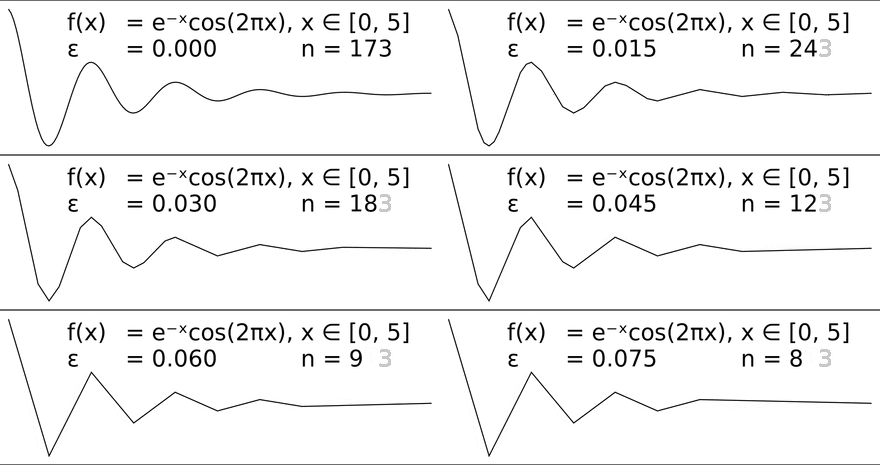
Applying RDP independently to each polygon shrank the data to about 11 MB.
However, this naive approach had a fundamental correctness problem
(tzf#183): adjacent timezone
polygons share edges, but each polygon is simplified in isolation. Because D-P
removes different intermediate points from each side of a shared boundary, the
two polygons end up with slightly different edge shapes — producing gaps and
overlaps that are invisible in the raw data but appear after simplification.
The DefaultFinder’s ±0.02° spatial-tolerance fallback was a workaround for
this, not a real fix.
Topology-aware approach
The fix is to integrate RDP simplification into a topology-aware pipeline that processes shared boundaries consistently across all adjacent polygons. Before any simplification takes place, a topology graph is built over all polygon rings:
- Normalize windings (CCW exterior, CW holes) so adjacent rings traverse a shared boundary in opposite directions — this is what makes reverse-edge matching reliable.
- Remove zero-length edges from source data (some rings contain duplicate adjacent vertices that break shared-edge detection).
- Snap T-junction vertices: if a topology node falls on the interior of an adjacent edge, insert it as a new vertex before analysis begins.
- Detect shared edges via canonical-key hashing. Classify each segment:
- Fixed: vertices where three or more rings meet. These anchor points must not move.
- Shared segment interior: free to be simplified, but only once — all partner rings reuse the same simplified result.
- Non-shared: simplified independently (coastlines, standalone boundaries).
- Enclave rings (a hole whose shape equals an inner timezone’s exterior) are handled specially: both partner rings rotate to the lexicographically smallest vertex (canonical start) and enter a shared simplification cache, guaranteeing identical output without any fixed vertices.
- Fallback: rings that simplify to fewer than 3 unique points, produce zero-length edges, or (for small rings ≤ 100 pts) are self-intersecting revert to the original unmodified input ring.
This topology-aware approach was completed in Spring 2026. Its implementation
is documented ininternal/topology/README.md.
Result: 86% point reduction (8 M → 1.09 M points) with topologically consistent shared boundaries — no gaps, no unintended overlaps.
Stage 2 — Shared-edge deduplication
After simplification, long shared boundary segments still appear twice in the
file — once per adjacent timezone ring. The deduplicatetzpb tool converts
the Timezones binary into a TopoTimezones format that stores each shared
segment only once:
- A global
SharedEdgelibrary indexes each long shared boundary segment by ID. - Each ring becomes a sequence of
RingSegmententries: either a short inline point sequence (≤ 10 pts) or a forward/reversed reference to aSharedEdgeID.
Winding normalization must run before this step for the same reason it must run before simplification: only when adjacent rings traverse their shared boundary in opposite directions does the deduplication recognise them as the same edge (rather than classifying them as disputed-territory same-direction overlaps).
Result on the simplified data: ~20% further size reduction
(12.5 MB → 10.0 MB). The TopoTimezones format also round-trips cleanly back
to full polygons, which makes it a useful interchange format for downstream
tools.
Stage 3 — Polyline encoding
The final offline stage applies Google Maps’ Encoded Polyline algorithm to
compress the coordinate sequences stored in TopoTimezones. Geographically
sequential points have small deltas, so delta + zig-zag encoding achieves
roughly 45% additional compression on the simplified and deduplicated data.
Shared-edge point sequences and inline segment points are delta-encoded; edge ID references (int32 forward/reversed references) pass through unchanged.
Result: 10.0 MB → 5.4 MB (CompressedTopoTimezones), for a combined
pipeline reduction of 94% from the raw 96 MB source.
Runtime query optimization
Tile-based indexing
A naïve Ray Casting approach operates in O(n²) time, which is unsuitable for high-concurrency backend services. We considered spatial R-trees but found minimal performance gains given the small number of global time zones and their uneven area distributions.
Instead, we adopted a tile-based indexing scheme inspired by map tile formats used in weather data services. Each tile defines a quadrilateral region at a given zoom level:
┌───────────┬───────────┬───────────┐
│           │           │           │
│           │           │           │
│ x-1,y-1,z │ x+0,y-1,z │ x+1,y-1,z │
│           │           │           │
│           │           │           │
├───────────┼───────────┼───────────┤
│           │           │           │
│           │           │           │
│ x-1,y+0,z │ x+0,y+0,z │ x+1,y+0,z │
│           │           │           │
│           │           │           │
├───────────┼───────────┼───────────┤
│           │           │           │
│           │           │           │
│ x-1,y+1,z │ x+0,y+1,z │ x+1,y+1,z │
│           │           │           │
│           │           │           │
└───────────┴───────────┴───────────┘
This quadtree-like layout ensures parent tiles contain exactly four child tiles, allowing aggregation without gaps:
Tile-based timezone index demo. A live demo showing polygons and their index is available via tzf-web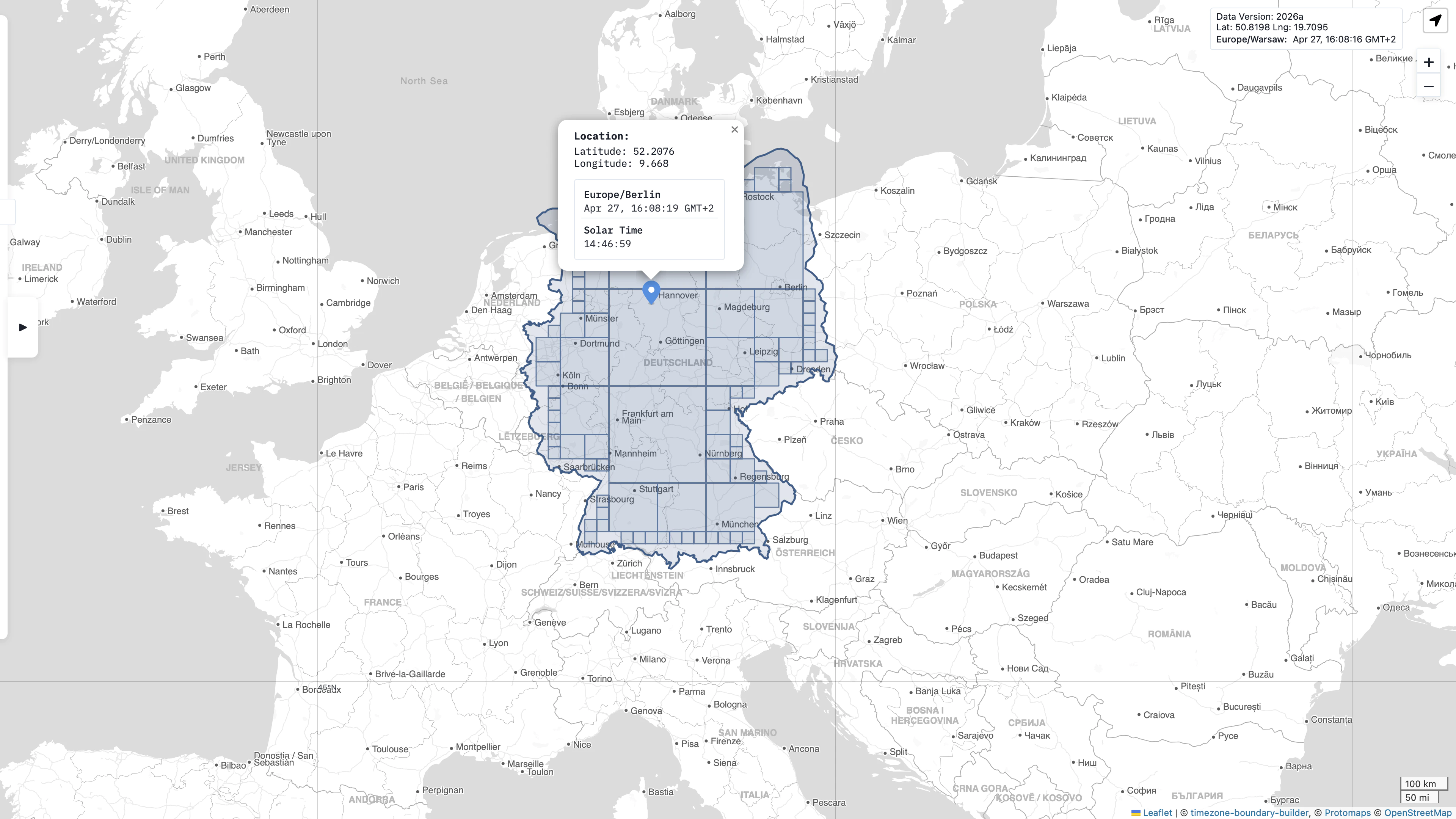
Each timezone is processed independently. For each timezone:
- Generate all tiles at the index zoom level (zoom 13) that touch the polygon.
- Keep only tiles that fall entirely within the polygon (
EnsureInside). - Drop edge tiles — tiles where any of the 8 surrounding neighbors are absent from the
set. This step is applied twice (
dropEdgeLayer = 2), peeling back two layers from the interior boundary so that tiles near the polygon edge are excluded. - Merge the remaining tiles upward to the aggregation zoom level (zoom 3) via
MergeUp, then applyEnsureInsideagain on the merged result.
Because each timezone is indexed independently, a tile that falls inside multiple
timezones appears in all of their index entries. The in-memory map ismap[Tile][]string, so a single tile can return several timezone names. This handles
shared areas such as Asia/Shanghai and Asia/Urumqi, whose overlapping interior region
generates matching tiles in both timezones’ preindex entries.
When querying a point, the lookup walks from the coarsest zoom (3) to the finest (13) and returns all timezone names at the first matching tile:
- If a matching tile is found → return its timezone list (one name for unambiguous interior tiles, multiple names for shared-area tiles).
- If no tile matches (border region, coastline, sparse area) → the preindex returns nothing.
In v1 this preindex backed a separate FuzzyFinder, which returned no result for
uncovered areas and left the empty case to the caller. v2 removed that class. The
preindex is now the fast path inside every finder whose file carries a FUZZY
section: a covering tile answers GetTimezoneName immediately, and an uncovered
point falls through to polygon lookup within the same finder. GetTimezoneNames
does not consult the preindex in any finder.
The preindex is built offline and stored as section type 10 of the embedded
binary file rather than as a separate artifact. On the 2026c dataset it holds
87,572 tiles, 156 of which name two timezones, in about 880 KB.
1°×1° Grid Index
Starting from tzf v1.2.0 / tzf-rs v1.3.3, the distributed binary embeds a 1°×1° grid index built automatically at the end of the compress stage; in v2 it is section type 8 of the embedded binary file. The globe is partitioned into 360 × 180 = 64,800 cells; each cell stores the sorted list of timezone indices whose bounding box intersects it. Only cells that contain at least one timezone are stored (~65,000–65,500 worldwide), adding roughly 870 KB to the distribution files.
At query time, Finder performs an O(1) map lookup to reduce PIP candidates from
~444 timezones to typically 1–3. When a cell contains exactly one candidate and the
query point is away from the antimeridian and poles, the PIP test is skipped entirely.
Files built without a grid index fall back transparently to the original full linear
scan, so the API is unchanged for callers using older data.
Inspired by twitchax/rtz.
YStripes index
Starting from tzf v1.1.0 (Go) and tzf-rs v1.2.0 (Rust), the polygon-level point-in-polygon
test uses a YStripes spatial index, ported from Josh Baker’stidwall/tg project.
YStripes improves on naive ray casting by pre-partitioning each polygon’s edges into horizontal stripes. For a query point, only edges in the relevant stripe are tested, reducing per-polygon work substantially without the overhead of a full spatial tree.
v1 allowed disabling it through FinderOptions in Rust; v2 removed that option
and the index is always built. The .tzm loader rebuilds it in parallel at open,
which costs about 5 ms on the lite dataset with 16 cores and 28 ms at one core.
Section type 14 of the embedded binary format reserves a serialized form of the
index, which is not emitted today.
For algorithm details, see the author’s explanation inPOLYGON_INDEXING.md.